Samudra Manthan, or the tale of the ‘Churning of the Ocean of Milk’, is one of the most famous episodes in the Puranas, and is celebrated in a major way every twelve years at the Kumbh Mela. The tale is described in the Shrimad Bhagavatam, the Mahabharata, the Ramayana, and various Puranas, including the Bhagawat, Brahma-vaivarta, Agni, and Vishnu Purana. Through its symbolism, it relates to spiritual development leading to union with God.
“Manthanam” is the Sanskrit equivalent of ‘Manthan’ meaning ‘to churn’. In the phrase “sagar Manthan”, ‘sagar’ is another word for ‘Samudra’, both meaning an ocean and large water body. The term “kshirsagar Manthan”, ‘kshirsagar’ literally means the ‘Ocean of Milk’.
The tale begins with King Indra who, while riding on his vahana elephant, came upon the sage Durvasa, who offered him a special garland. Indra accepted the garland but put in on the trunk of the elephant. The elephant was irritated by the bees who were attracted to its perfume, and threw the garland onto the ground, thus enraging the sage, as the garland was a dwelling of Sri (fortune), and was to be treated as prasada. Durvasa Muni therefore cursed Indra and all the Devas to be bereft of strength, energy, and fortune.
In numerous battles that followed this incident, the Devas were defeated and the Asuras, led by King Bali, gained control of the universe. Finally the Devas sought help from Lord Vishnu, who advised them to treat the Asuras in a diplomatic manner. The Devas therefore formed an alliance with the Asuras, and they cooperatively set out to churn the ocean for the nectar of immortality, Amrita, to be shared among them. Lord Vishnu, however, had ensured the Devas that He would arrange it so they alone obtained the nectar.
However once the mountain was placed in the ocean, and the churning began, it started to sink, so Vishnu in His form as Kurma, the tortoise, came to their rescue and supported the mountain on His shell. The churning of the Ocean of Milk was an inconceivably elaborate process. Mount Mandaranchal was used as the churning rod and Vasuki, the King of the Nagas, served as the churning rope. The demigods held Vasuki’s tail while the demons held his head. Each side pulled alternately, thereby causing the mountain to rotate and churn the ocean.
Various differences are found in some versions of the tale. For example, in the Mahabharata it is described that Akupara, the King of Tortoises, took the form of Kurma at the request of the Devas and Asuras.
Halahala (Poison)
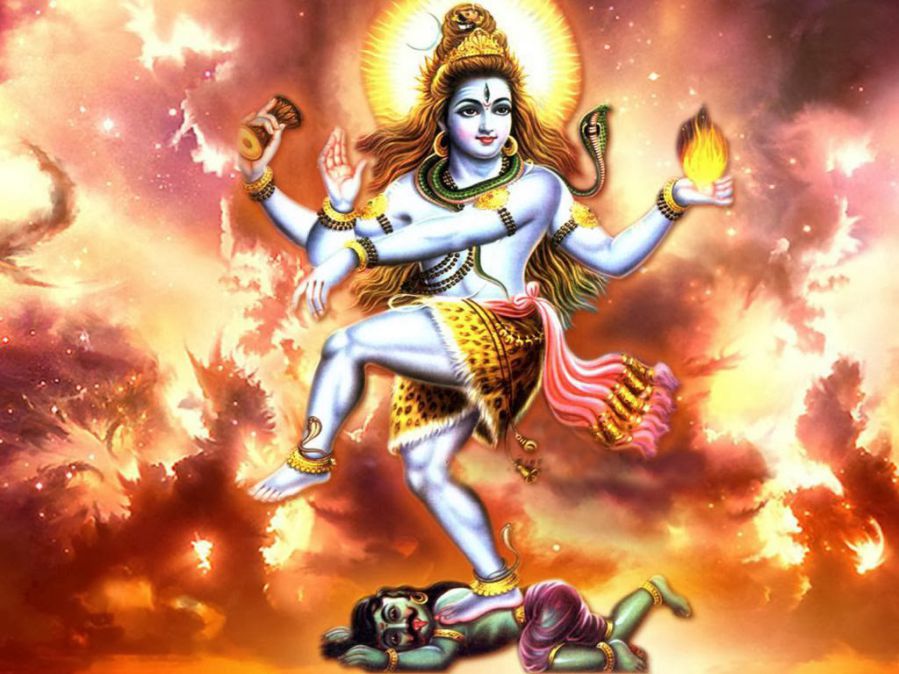
Due to the churning of the Milk Ocean by the Asuras and Devas, along with other things, a pot of poison called Halahala, or ‘kalakuta’, was produced from the ocean. This terrified the demigods and demons, because the poison was so toxic that it could wipe out the entire manifest creation. It intoxicated the Asuras. On the advice of Vishnu, the demigods approached Lord Shiva for help and protection. Out of compassion for the living entities, Shiva drank the poison, which was so potent that it changed the colour of Shiva’s neck to blue. For this reason, Shiva is also called Neelakantha, the blue-necked one (‘neela’ means ‘blue’ and ‘kantha’ means ‘throat’). It is also described that Parvati, alarmed at her husband’s drinking of the poison, stopped it in his throat with her hands, thus earning him the name Vishakantha (the one who held poison in his throat).
Ratnas
Fourteen different Ratnas (gems) were also recovered during this tale of churning, and these were mostly kept by the demigods, although the Asuras tried to cheat them out of the treasures. All kinds of herbs were cast into the ocean to produce these fourteen ratnas, which were divided between the Asuras and demigods, as follows:
- Lakshmi, the Goddess of Fortune and Wealth
- Kaustubha, the most valuable jewel in the world
- Parijata, the wish-fulfilling tree
- Varuni, goddess and creator of intoxicating beverages
- Dhanvantari, the doctor
- Chandra, the moon
- Kamadhenu, the wish-granting divine cow
- Kalpavriksha, the wish-granting tree
- Airavata, the elephant of Indra
- Apsaras, various divine nymphs like Rambha, Menaka, Punjikasthala, etc.
- Uchhaishravas, the divine 7-headed horse
- Sharanga, the bow of Vishnu
- Amrita, the nectar of immortality.
- Shankha, Vishnu’s conch
Again, this list varies from Purana to Purana and is also slightly different in the Ramayana and Mahabharata.
The Nectar of Immortality
Finally, Dhanvantari, the heavenly physician, emerged with a pot containing the Amṛita, the heavenly nectar of immortality. Fighting ensued between the Devas and the Asuras for its possession. The Asuras took the Amrita from Dhanvantari and ran away.
But the Devas appealed to Vishnu, who then took the form of Mohini. As the beautiful and enchanting damsel, Mohini distracted the Asuras, took the Amrita, and distributed it amongst the Aditya, who drank it. One Asura, Rahu, disguised himself as a Deva and drank some of the nectar. Due to their luminous nature, the Sun God Surya and the Moon God Chandra noticed the switching of sides. They informed Mohini, and before the Nectar could pass his throat, Mohini cut off Rahu’s head with Sudarshana Chakra.
Realizing that they had been deceived, the Asuras engaged in combat with the Devas, who had been bolstered by their consumption of Amrita. Rejuvenated by it, the Devas emerged victorious and exiled the Asuras to the Patalaloka, regaining Svarga.
Origin of the Kumbha Mela

Triveni Sangam, Prayagraj. On the left, the Yamuna river, on the right, Ganga (the Ganges); the ethereal Saraswati is invisible.
While the Asuras were carrying the Amṛita away from the Devas, some drops of the nectar fell at four different places on Earth: Haridwar, Prayaga (Prayagraj), Trimbak (Nashik), and Ujjain. These places thus acquired a certain mystical power and spiritual value. A Kumbha Mela is celebrated at these four places every twelve years for this reason. It is said that after bathing there during the Kumbha Mela, one can more easily attain moksha.

Kumbha Mela scene at Prayagraj (Allahabad)